Sunday, January 23, 2022

Colonel Fazackerley Butterworth-Toast


2. Answer the following questions. 

a. Where does the Colonel encounter the ghost? Is he prepared for this meeting?

The Colonel encountered the ghost in the old castle which he had bought recently. He was not prepared for the meeting.

b. What was the ghost's first reaction on seeing Colonel Fazackerley?

The ghost shot out of the chimney and shouted 'beware' furiously on seeing Colonel Fazackerley. 

c. Who did the Colonel mistake him to be? Why do you think so?

The Colonel mistook the ghost as a person who was going to a Fancy Dress Ball. I think so because the ghost came out of the chimney.

d. What did the ghost do to scare the Colonel?

The ghost floated about between ceiling and floor. He walked through the wall and returned through a pane. He went up the chimney and came back. He did all these things to scare the Colonel.

e. Why was the Colonel feeling weak?

The Colonel laughed merrily at the actions of the ghost to scare him. So he felt weak.

f. Why did the ghost disappear?

The ghost disappeared as all his efforts to scare the Colonel were in vain.

g. What did the Colonel feel? Why he could not call back the ghost?

The colonel felt pity as the ghost had disappeared. He could not call back the ghost as he didn't know his name.

h. What part of the poem did you find the funniest?

Instead of being afraid, the Colonel wanted to invite the ghost to his house-warming party. Then the ghost lost his wits and rattled his chains and clattered his bones filling the whole caste with terrible sounds. The Colonel asked the ghost to it once again. I find this part of the poem the funniest.

Lob's Girl


 2. Answer the following:

a. A simile is a literary device that compares two things using the words ‘like’ or ‘as’.

The simile ‘like a sand-colored bullet’ is used to describe Lob. In your own words, what does this simile mean?

This simile means that sand-colored Lob ran as fast as a bullet to fetch the stick to Sandy.

b. For both Sandy and Lob it was love at first sight. Give reasons to support your answer.

Lob found Sandy on the beach. He started licking Sandy affectionately and with enthusiasm. Sandy wasn’t afraid of the unknown dog licking her. She thought that he is beautiful and started playing with him. She threw a driftwood stick and he fetched it. Thus, it was love at first sight for both Sandy and Lob.

c. How does Lob show his devotion to Sandy as he continuous to return to her throughout the story?

Lob showed his devotion to Sandy by walking about 400 miles two times. Even after death, Lob appeared at the hospital to see Sandy. Such was Lob’s devotion to Sandy.

d. Describe Sandy’s condition before and after Lob’s visit. What does reveal about the strength of their bond?

Before Lob’s visit Sandy’s condition was very critical. At the sound of Lob’s whine, Sandy stirred and opened her eyes. She moved her broken left arm to pat Lob. It reveals that the strength of their bond helped in the recovery of Sandy.

e. Sandy and Lob developed an inseparable bond. This communicates the message that true loyalty and strong relationships can withstand any circumstances -  natural or supernatural. Explain.

The bond between Sandy and Lob was inseparable. When Lob was taken away by his owner, Lob took a risky four hundred mile walk two times. This separation was natural. Lob was killed as he was hit by a speeding truck. After his death, Lob visited Sandy who was in critical condition at the hospital. This is quite supernatural.

f. Justify the title of the story.

The title of the story is “Lob’s Girl”. It is very appropriate as Lob had chosen Sandy as his owner. He risked a four hundred mile walk two times to be with her. He ever appeared to help in the recovery of Sandy supernaturally after his death. It is Lob who was devoted to his owner, Sandy.

Saturday, January 22, 2022

The Stalled Ox


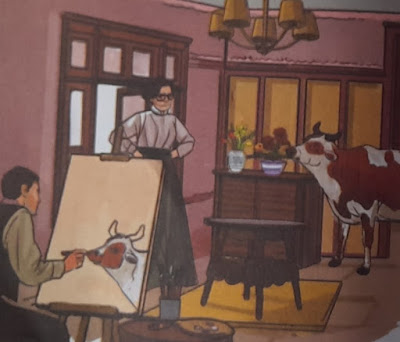
1. Why Theophil Eshley is called a cattle painter by force of environment?
Eshley was a talented painter. He started painting cattle not because of his love for cattle, but because of the circumstances and environment in which he lived. His home was in a villa dotted, semi-suburban, park-like area. A neighbor's cows grazed in a nearby meadow. Eshley saw cows, gardens, flowers, grass and walnut trees and started painting cows. Thus Theophil Eshley was called a cattle painter by force of environment.

2. What did Adela expect Eshley to do? Was it fair of her to expect so? Give reasons.
Adela was a neighbor of Eshley. She knew that Eshley painted cows. One day an ox strayed into her garden and started eating her flower plants. She was alone and she went to Eshley seeking help in driving away the stray ox. She expected Eshley to remove the ox from her garden. It was not fair of her to expect so. Eshley was only a painter of dairy cows and he had no experience in managing stray ox.  

3. What was Theophil Eshley's connection with cows and oxen?
Theophil Eshley lived in a villa dotted, semi suburban, park-like area. A neighbor's cows grazed in a nearby meadow. Eshley saw cows, gardens, flowers, grass and walnut trees and started painting cows. He became a well-known painter of dairy cows. He has no experience of any king with ox.

4. Theophil Eshley studied the ox like an artist. What all did he notice?

Theophil Eshley was an artist. He took to painting cows. One day his neighbor asked him to remove an ox from her garden. He went to her garden and saw a huge spotted ox in the garden. The ox was dull red about the head and shoulders. The ox's flanks and hindquarters were dirty white. The ox had shaggy ears and large blood-shot eyes.

5. What efforts did Theophil Eshley make to drive the ox away? What was the reaction of the ox?

Theophil Eshley tried to drive away the ox by making sound by clapping and shooing. The ox hadn't given any indication of moving. Then Eshley picked up a pea stick and flung it towards the ox. Realizing that he had to move the ox pushed its way through the French window into Adela's morning-room. 

6. Why was Adela disappointed at having sought help from Eshley?
Adela thought that Eshley could be good at changing an ox away as he paints cows. She had mistakenly assumed that Eshley would know about managing an ox. She realized her mistake when Eshley failed to remove the ox from her garden. So, she was disappointed at having sought help from Eshley.

7. The episode was the turning point in Eshley's artistic career. Which episode is being talked about here? How was it a turning point?

The episode of Eshley's efforts to drive the ox away from Adela's garden resulted in the remarkable picture, "Ox in a morning-room, late autumn," It  was one of the sensations and successes of the next Paris Art Exhibition, and when it was later exhibited at Munich it was bought by the Bavarian Government.  From that moment, his success was continuous and assured. 

8. Discuss the title of the story.

The title of the story, 'the stalled ox' is quite appropriate. The word 'stalled' means to stop suddenly. In the story an ox had stalled in a neighbor's garden. The ox enters Adela Pingsford's garden and starts eating her flower plants. The ox refuses to leave in spite of Eshley's efforts to shoo him away. Instead of going out, the ox enters the morning-room and stays there long enough for Eshley to paint his masterpiece.

Thursday, December 9, 2021

Her First Party

Reading [Page 64]

2. Answer the following questions.

a. Why had Mother given her consent to her children to attend the party?

Millie and her brother Bob had convinced Mother that it was the first-ever grown-ups party that Millie would attend. They further told her that there would be charades, tableaus, and recitations in which Millie was to take a leading role. So, Mother had given her consent.

b. Why were Bob and Millie looking forward to the party?

Millie and Bob were looking forward to the party as it was being given by Bob’s class at the College Hall. Moreover, there would be charades, tableaus, and recitations in which Millie was to take a leading role.

c. What were Millie’s apprehensions about the party?

Millie was afraid that something might go wrong and prevent her from going to the party. She feared that the weather might be bad, the party dress might catch fire, or she might sprain her ankle. In addition to these, her aunt Mildred was ill.

d. A dread that for the moment made her feel faint took possession of Millie.

i. What had alarmed Millie?

A letter from aunt Jane alarmed Millie.

ii. What was her fear?

She feared that there would be some bad news about her aunt Mildred in the letter.

iii. Was her dread misplaced?

No. Her dread was not misplaced. It turned out that the doctors had given up hope on Mildred’s recovery.

e. What did Millie do with the letter? What were her thoughts that made her decide so?

Milled hid the letter by keeping it in her pocket. She thought that one day would not make any difference.

f. What were Millie’s first thoughts as she dressed for the party?

Millie thought of delivering the letter to her mother as she dressed for the party.

g. What made Millie change her mind?

The joyous and merry time that she would have at the party made Millie change her mind.

h. How did the mood at home change after Mother read the letter?

The mood at home changed to sorrowfulness after Mother read the letter.

i. Do you empathize with Millie’s preoccupation with attending the party? Why/Why not?

Yes. I empathize with Millie’s preoccupation. She could not miss the party and at the same time, she could not forget that she hid the letter.

j. “It seems to me she has gained something.” What had Millie gained?

Millie had gained the wisdom of coping with the realities of life. One cannot enjoy when one’s near and dear are not okay.

Journey to the Centre of the Earth

Reading 1 Page 106

2. The three men were walking on bones; yet the scene Is not gruesome. Why?

The three men were drawn by enthusiastic curiosity to find out the marvels in the bowels of the earth. That is why the scene is not gruesome.

3. Describe the mastodons and their keeper.

Mastodons were gigantic animals that look like elephants. They were tearing down large boughs and eating masses of leaves and green branches. The keeper of these mastodons was a human being. He was above twelve feet tall. His head was as big as the head of a buffalo. He carried a branch of a tree to be used as a crook.

4. Why do you think was the dagger left behind? Was it done on purpose?

The dagger was left behind to indicate the right road to the interior. It was done on purpose. The dagger might have belonged to Arne Saknussemn, who ventured into the earth before them.

5. There are three different terrains described in the story. How are these different from each other?

Bone-filled ground, illuminated forest, and the shore of the central sea are the three different terrains described in the story.

Bone-filled ground contained scattered hills over the ground occupied by the plain of bones. It appeared like a tropical country area during midday summer.

The forest contained wild vegetation of the Tertiary period. It has gigantic mammals and the land was covered with mosses and ferns.

The shore of the central sea had certain groups of rocks. Streams and cascades fell over the projections of rocks.

6. What was the most important discovery in this story? Why do you think so?

I think that the finding of the dagger was the most important discovery in this story. The dagger proved beyond doubt that a sixteenth-century explorer, Arne Saknussemm had travelled there before.

Reading 2 Page 107

1. Foreshadowing is an advance sign or warning of what is to come in future. Before the men spot huge creatures, you are in a way anticipating something like this. Quote words/phrases from the story that you feel prepare you for this.

We can find foreshadowing in the following sentence.

‘Since nature had shown herself capable of producing such stupendous vegetable supplies, why might we not meet with mammals just as large, and therefore dangerous?’

2. In the extract, it is perseverance that guides the men along the way. As a result, they gain knowledge. Justify.

The men in the story ventured into unknown depths of the earth by braving several hardships. They overcame physical tiredness, dangerous grounds, gigantic animals, and all sorts of difficulties. Because of their perseverance, they could finish their adventurous journey successfully and gain knowledge.

3. The lesson you just read is a piece of fiction but it also has some scientific truths. What are they?

The scientific truths that are evident in the fictional lesson are 1. Craters made by extinct volcanos lead to the underground. 2. The existence of giant elephant-like mammals. 3. Earth is covered by a thin layer of upper crust.

Wednesday, December 1, 2021

Imagination


2. What games did the poet play as a child? What impact did they have on him?

The poet used to play pirates and sail seven seas. He used to imagine himself as a cowboy. These simple things made him happy.

3. The poet’s life is unlike the books he reads. Quote from the poem to validate this?

The poet’s life is unlike the books he reads. His life is an ordinary life whereas the lives of the characters of the books he read were heroic lives. His own words in the poem, …..’I discovered the joy of reading, And escaped the daily grind’ validate this.

4. What was the impact of science fiction on his life?

The poet had read a science-fiction book written by Jules Verne. He felt that he went on to the moon just to take a look. He continued to be attracted by such books even after he became an adult.

5. Allusion is a figure of speech in which an object or circumstances briefly and directly refers to another person, place, thing, or object. In the fifth stanza, the speaker alludes to two people. Find out who they are. What do these allusions convey?

David Livingstone and Huckleberry Fin are the two people mentioned in the fifth stanza. David Livingstone was a famous explorer of the African continent. Huckleberry Fin was a mischievous fictional character in Mark Twine’s book. These allusions conveyed that the poet liked the spirit of adventure, mystery, and mischievousness.

6. What impact did growing up have on the poet?

Growing up means leaving childhood and becoming an adult. The poet says that as he grew up, his childish world has ended. His imagination gave way to practical thinking. He says that though he still loves mystery, his outlook has changed.

Tuesday, November 23, 2021

Emperors on Ice


 2. What did the scientists want to establish after studying the eggs?

The scientists wanted to establish that the analysis of the emperor penguin’s embryos would reveal links between all birds and their reptile predecessors. It was incorrectly thought that the emperor penguin was one of the most primitive birds of our planet earth.

3. What additional benefits did they expect to achieve through this journey?

Henry Bowers, Edward Wilson, and Apsley Cherry-Gerrard took the journey to Cape Crozier. They wanted to bring some penguin’s embryos for some scientific experiments. Additionally, they would gain some knowledge to continue further pole journeys. They could try out various combinations of sledging rations under extreme filed conditions. They could collect data from the Great Barrier in winter to use in the predictions of weather.

4. What motivated Wilson to undertake this difficult journey?

The chance of continuing the study of the breeding biology of birds is the motivation for Wilson to undertake this difficult journey.

5. What was the curator’s first reaction when he saw the eggs?

The curator of the American Museum of Natural History insulted Cherry-Gerrard who presented the eggs by asking him who he was and informing him that the museum was not an egg shop.